Ads-Banner Header

Tampilkan postingan dengan label Document Tools. Tampilkan semua postingan

17 Juni 2013

Nitro PDF Professional 8.1.1.12 (x86 x64) - incl. keygen

Nitro PDF Professional 8.1.1.12 (x86 x64) - incl. keygenFree Download Nitro PDF Professional 8.1.1.12 (x86 x64) - incl. keygen. Sahabat [civiliana], setelah sebelumnya kami sempat memposting Nitro PDF Professional 7.4.1.1 (x86/x64) kini kami akan sharing Nitro PDF Professional 8.1.1.12 (x86 x64) - incl. keygen. Sesuai dengan namanya, tentunya sahabat [civiliana] sudah tahu kegunaan dari software ini. Selain ukuran installernya yang lumayan kecil (dibandingkan dengan kegunaannya), dari pengalaman kami menggunakan software ini selama beberapa tahun bahwa software ini sangat powerfull. Untuk urusan edit-mengedit atau konvert-mengkonvert, software ini kinerjanya sangat baik.
Mungkin juga sahabat [civiliana] punya pengalaman dalam menggunakan software ini, silahkan di-share. :D
Screenshoot :
Nitro PDF Professional 8.1.1.12 (x86 x64) - incl. keygen
SYSTEM REQUIREMENTS :
  • Desktops: Windows® XP, Windows® Vista, Windows® 7, Windows® 8;
  • Servers: Windows® Server 2003, Windows® Server 2008, Windows® Server 2008 R2 (Terminal Server and Citrix XenApp/Access Essentials configurations supported.)For more on server-side deployment, check out the Citrix and Terminal Server software page;
  • Processor: 1 gigahertz (GHz) or faster processor;
  • RAM: 512 MB system memory (1 GB recommended);
  • Display: 1024x768 screen resolution;
  • Hard disk space: 300 MB of available hard disk space;
  • Microsoft Office 2003 or newer (required for Microsoft Office integrated features).
Note : Compatible with Windows 32-bit and 64-bit.
* Testing by [civiliana] with Windows 8 Enterprise 64-bit.

Official Site : http://www.nitropdf.com

10 Juni 2013

Maplesoft Maple.16.00 (x86 x64) - incl. patch

Maplesoft Maple.16.00 (x86 & x64) incl. patchFree Download Maplesoft Maple.16.00 (x86 & x64) incl. patch. Sahabat [civiliana], software yang kami posting kali ini Maplesoft Maple 16 mungkin bisa dibilang software yang sudah agak jadul, karena saat ini Maplesoft sudah merilis Maple versi 17. Namun mengingat fungsi dan kegunaannya, kami putuskan tetap memposting Maple 16 ini. Karena saat ini masih banyak sahabat [civiliana] yang tetap meminta software Maple 16 ini... Untuk feature-featurenya, kalau ingin tahu sahabat [civiliana] lihat saja langsung di situs resminya, ya... :D
O iya sahabat [civiliana] sekedar informasi, bahwa pada waktu lalu kami juga sempat memposting Maplesoft Maple 15 - full crack.
Selanjutnya untuk persyaratan sistem yang dibutuhkan oleh Maple 16 ini, silahkan dilihat pada keterangan dibawah.
Screenshoot :
Microsoft Visio Professional 2013
SYSTEM REQUIREMENTS :
  • Processor:
    Pentium III ; 1 GHz Processor or higher;
  • Memory:
    Memory 2 GB of RAM (recommended);
  • Hard disk:
    2 GB Harddisk Space;
  • Operating system:
    Windows XP, Windows 2008 Server, Windows Vista, Windows 7 or Windows 8;
  • Graphics:
    16-bit color at 1024 by 768 (or greater) resolution recommended;
  • Other:
    Java Runtime Environments 1.6.0 or Higher Installed.
Note : Compatible with Windows 32-bit and 64-bit.
* Testing by [civiliana] with Windows 8 Enterprise 64-bit.

Official Site : http://www.maplesoft.com

14 Juni 2012

ebook - Microsoft Project 2010 : Step by Step

Microsoft Project 2010 : Step by Step | Carl Chatfield, PMP and Timothy Johnson, MCP | Microsoft Press | 2010 | English | 505 p | pdf | 29.41 MB | ISBN: 0735626952 | Microsoft Project 2010 is a powerful program that helps you plan and manage a wide range of projects. From meeting crucial deadlines and budgets to selecting the right resources, Project 2010 offers easier and more intuitive experiences to help you be more productive and realize better results. If you’re upgrading to Project 2010 from a previous version, you’re probably most interested in the differences between the old and new versions and how they will affect you. The following sections list new features you will want to be aware of, depending on the version of Project you are upgrading from.
ebook - Microsoft Project 2010 : Step by Step
Book Title
:
Microsoft Project 2010 : Step by Step
Author
:
Carl Chatfield, PMP and Timothy Johnson, MCP
Publisher
:
Microsoft Press
Year
:
2010
Language
:
English
Page
:
505
File Format
:
pdf
File Size
:
29.41 MB
Introducing Microsoft Project 2010
Microsoft Project 2010 is a powerful program that helps you plan and manage a wide range of projects. From meeting crucial deadlines and budgets to selecting the right resources, Project 2010 offers easier and more intuitive experiences to help you be more productive and realize better results. You can use Project to:
  • Create project plans at the level of detail that’s right for your project. Work with summary data initially or shift to a more detailed approach when it’s convenient. Control what tasks Project can schedule automatically or that you’ll schedule manually.
  • Manage tasks, costs, work, and resources at whatever level of detail is appropriate for your project’s needs.
  • See your project plan data in a variety of views. Apply grouping, highlighting, sorting, and filtering to see your data the way that you want.
  • Track and manage your project plan throughout project execution.
  • Collaborate and share data with others in your organization using a variety of productivity applications.
  • Use resource pools, consolidated projects, and cross-project links to extend your project management focus across multiple projects.
Project 2010 builds on previous versions to provide powerful project management tools. This introduction provides an overview of new features that we explore throughout the book.
New Features
If you’re upgrading to Project 2010 from a previous version, you’re probably most interested in the differences between the old and new versions and how they will affect you. The following sections list new features you will want to be aware of, depending on the version of Project you are upgrading from.
Contents at a Glance
Table of Contents
Introduction
Part 1 Simple Scheduling
1
A Guided Tour of Project
2
Creating a Task List
3
Setting Up Resources
4
Assigning Resources to Tasks
5
Formatting and Sharing Your Plan
6
Tracking Progress on Tasks
Part 2 Advanced Scheduling
7
Fine-Tuning Task Details
8
Fine-Tuning Resource Details
9
Fine-Tuning Assignment Details
10
Fine-Tuning the Project Plan
11
Organizing Project Details
12
Tracking Progress on Tasks and Assignments
13
Viewing and Reporting Project Status
14
Getting Your Project Back on Track
Part 3 Special Subjects
15
Applying Advanced Formatting and Printing
16
Customizing Project
17
Sharing Project Information with Other Programs
18
Consolidating Projects and Resources
Part 4 Appendices
A
A Short Course in Project Management
B
Roadmap for Developing Your Project and Project Management Skills
C
Using the Practice Files if Connected to Project Server
D
Using Microsoft Project 2010 Step by Step in a Classroom: Suggestions for Instructors
Glossary
Index

07 Juni 2012

Microsoft Access 2010 ebook Series

Microsoft Access 2010 ebook seriesFree Download - Microsoft Access 2010 ebook Series, Is a collection of eBooks Microsoft Access 2010. Consists of five books, including: Microsoft Access® 2010 Bible, Access 2010 The Missing Manual, Microsoft® Access® 2010 VBA Programming Inside Out, Microsoft® Access® 2010: Complete; SHELLY CASHMAN SERIES, and Micrososft® Access® 2010 In Depth.
All of which you can download for free.
Access® 2010 Bible
Author
:
Michael R. Groh
Publisher
:
Wiley Publishing, Inc.
Year
:
2010
Language
:
English
Page
:
1395 p
File Format
:
pdf
File Size
:
29.01 MB
Free download ebook - Access® 2010 Bible.
ebook - Access 2010 The Missing Manual
Author
:
Matthew MacDonald
Publisher
:
O’Reilly Media, Inc.
Year
:
2010
Language
:
English
Page
:
832 p
File Format
:
pdf
File Size
:
11.91 MB
Free download ebook - Access 2010 The Missing Manual.
Microsoft® Access® 2010 VBA Programming Inside Out
Author
:
Andrew Couch
Publisher
:
O’Reilly Media, Inc.
Year
:
2011
Language
:
English
Page
:
738 p
File Format
:
pdf
File Size
:
24.44 MB
Free download ebook - Microsoft® Access® 2010 VBA Programming Inside Out.
Microsoft® Access® 2010: Complete
Author
:
Gary B. Shelly; Philip J. Pratt; Mary Z. Last
Publisher
:
Course Technology,
Cengage Learning
Year
:
2011
Language
:
English
Page
:
564 p
File Format
:
pdf
File Size
:
33.97 MB
Free download ebook - Microsoft® Access® 2010: Complete, SHELLY CASHMAN SERIES.
Micrososft® Access® 2010 In Depth
Author
:
Roger Jennings
Publisher
:
Que
Pearson Education, Inc.
Year
:
2011
Language
:
English
Page
:
1548 p
File Format
:
pdf
File Size
:
127,49 MB
Free download ebook - Micrososft® Access® 2010 In Depth.

17 Mei 2012

Nitro PDF Professional 7.4.1.1 (x86/x64)

Nitro Pdf Professional 7.4.1.1
Nitro PDF Professional adalah salah satu software yang sangat powerfull, untuk mengelola file dokumen kerja anda. Nitro PDF profesional, berguna untuk membuat, mengubah, mengedit, menggabungkan, menganotasi, mengisi formulir, dan menyimpan file PDF dengan standar industri 100%. Anda dapat mengkonversi file Dokumen ke PDF atau sebaliknya.
Membuat, melihat & mengedit semua dokumen PDF Anda dan mendapatkan kendali penuh atas PDF Anda dengan hanya satu aplikasi. Membuat PDF dari Microsoft Office dengan satu klik dan mudah mengkonversi lebih dari 200 jenis file ke PDF. Menyalin, mengedit, dan memasukkan teks, grafis dan seluruh halaman. Menambahkan halaman, penomoran halaman, tanggal dan waktu-perangko. Menambahkan navigasi bantu seperti bookmark dan hyperlink. Untuk pengguna bisnis, Nitro memungkinkan Anda: markup dan review dokumen menggunakan sticky notes, highlighting, and comments. Mengkonfigurasi pengaturan keamanan, dan mengontrol hak pengguna lain untuk mencetak, mengedit, dan/atau menyalin pekerjaan Anda.
Features :
  • Creating PDF-documents from more than 300 file types.
  • onvert and merge multiple files into a PDF-document
  • Batch mode for converting files to PDF-format
  • Scan to PDF-format
  • Creating a PDF from Microsoft Word, Excel and PowerPoint, by pressing a single button
  • Automatic generation of" smart "PDF-documents with bookmarks, links, meta-data and the protection of Microsoft Office
  • Copy text with formatting
  • Export PDF for later in the program separate Microsoft Word, WordPerfect, OpenOffice and other office programs
  • A full export text and images from PDF-document
  • Batch mode for converting several documents
  • Inserting and editing text, including fonts, colors, size, etc.
  • Edit images - delete, add, resize, rotate, crop, replacement and removal
  • Editing images - brightness, contrast, saturation, etc.
  • Editing a PDF-document pages - insert, delete, rotate, crop, removal and replacement of elements
  • Adding headers and footers, watermarks, and text for all pages of the document
  • Add and edit bookmarks and hyperlinks
  • Auto-create links based on keywords and page numbers
  • Optimization, compression and recovery of PDF-documents
  • Edit document properties including metadata and initial view settings
  • Selecting text content using a selection tool, underscores, and crossing
  • Manually adding images, using the" Pencil "
  • Adding shapes to your images, such as lines, arrows, rectangles, ovals, polygons and clouds
  • Adding marks on document pages
  • The possibility of application documents
  • Adding text feedback
  • Sort and manage comments
  • Sending a document to print to the printer
  • Pleasant and stylish user interface in the style of Microsoft Office 2007
System Requirements :
  • Desktop : Windows® XP, Windows® Vista, Windows® 7 (x64 editions supported)
  • Processor : 1 gigahertz (GHz) or faster processor
  • RAM : 512 MB system memory (1 GB recommended)
  • Display : 1024x768 screen resolution
  • Available Space : Up to 520 MB of available hard drive space
  • Microsoft Office 2003 or newer (required for Microsoft Office integrated features)
  • Microsoft .NET Framework 2.0 (or above)
* Tested by : Windows 7 Enterprise x64 SP1
Official Site : http://www.nitropdf.com

05 Mei 2012

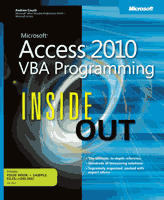
ebook - Microsoft® Access® 2010 VBA Programming Inside Out

Microsoft® Access® 2010 VBA Programming Inside OutBook Title : Microsoft® Access® 2010 VBA Programming Inside Out
Author : Andrew Couch
Publisher : O’Reilly Media, Inc.
Year : 2011
Language : English
Page : 738
File Format : pdf
File Size : 24.44 MB
Free download ebook - Microsoft® Access® 2010 VBA Programming Inside Out. Microsoft Visual Basic for Applications (VBA) is an exceptional programming language and environment. The language has grown out of a need to have a programming language that would allow more business-focused individuals to write programs, but equally support the programming features that developers look for in a product. The environment is as important as the language because of its unique features, allowing code to be quickly modified while being debugged.
The Access Basic language in early product versions evolved into the VBA language, which provided a cross-product language for the Microsoft Office products. This all coincided with the revolution of an event-driven approach to programming, which was very important, because the emphasis on being a programmer shifted from writing thousands of lines of code to writing snippets of code in response to events. This also led to a change of emphasis from writing large libraries of code to understanding how to manipulate the object models in the environment—a focus which has progressed with .NET, albeit using namespaces instead of object models.
Even with the introduction of object-oriented programming, VBA has kept pace with the expectations of modern programming. The two products that have shaped VBA the most are Microsoft Excel and Microsoft Access; Excel introduced VBA and originally gained VBA programming features in advance of these becoming available within Access.
A significant strength of VBA is that it is universal to the Microsoft Office suite of programs; all the techniques we describe in this book can be applied to varying degrees within the other Office products. A major turning point for these products was the ability through OLE Automation to be able to drive one product from another, and to cut and paste code between the different environments with a minimum amount of change to the code. This was a revolutionary feature introduced with the programming language of Access Basic, conforming to the new VBA standard established in Excel. VBA suddenly provided the longawaited platform for the simple integration of the Office products and building solutions that could easily exploit the strengths of each component product in the Office suite. The combination of Access and VBA offers an extremely productive environment within which to construct applications.
VBA has often been criticized for its simplicity as a language when compared to languages such as C++ and C#. Quite to the contrary, the big advantage of VBA is that this simplicity leads to more easily maintainable and reliable code, particularly when developed by people with a more business-focused orientation to programming. Looking toward the future, the emphasis in modern programming has moved from the language syntax to the intricacies of understanding the objects that the language manipulates, so the emphasis on the specific syntax of languages is starting to blur.
In the .NET world, the conflict between using VB.NET, which originates from VBA, and C# continues, because even though the objects being manipulated are now common, there are subtle differences between the languages, which means that developers moving from VBA to C# can often feel that they are being led out of their comfort zone, especially when they need to continue to use VBA for other applications.
Contents at a Glance
PART 1
:
VBA Environment and Language
Chapter 1
:
Using the VBA Editor and Debugging Code
Chapter 2
:
Understanding the VBA Language Structure
Chapter 3
:
Understanding the VBA Language Features
PART 2
:
Using Functions in Your Formulas
Chapter 4
:
Applying the Access Object Model
Chapter 5
:
Understanding the Data Access Object Model
PART 3
:
Working with Forms and Reports
Chapter 6
:
Using Forms and Events
Chapter 7
:
Using Form Controls and Events
Chapter 8
:
Creating Reports and Events
PART 4
:
Advanced Programming with VBA Classes
Chapter 9
:
Adding Functionality with Classes
Chapter 10
:
Using Classes and Events
Chapter 11
:
Using Classes and Forms
PART 5
:
External Data and Office Integration
Chapter 12
:
Linking Access Tables
Chapter 13
:
Integrating Microsoft Office
PART 6
:
SQL Server and SQL Azure
Chapter 14
:
Using SQL Server
Chapter 15
:
Upsizing Access to SQL Server
Chapter 16
:
Using SQL Azure
PART 7
:
Application Design
Chapter 17
:
Building Applications
Chapter 18
:
Using ADO and ADOX
Download Link :

20 April 2012

ebook - Access® 2010 Bible

Access® 2010 BibleBook Title : Access® 2010 Bible
Author : Michael R. Groh
Publisher : Wiley Publishing, Inc.
Year : 2010
Language : English
Page : 1395
File Format : pdf
File Size : 29.01 MB
Free download ebook - Access® 2010 Bible. Welcome to the Microsoft Access 2010 Bible, your personal guide to a powerful, easy-to-use database-management system. This book is in its eleventh revision and has been totally rewritten for Microsoft Access 2010 with new text, new pictures, and a completely new and improved set of example files.
This book examines Access 2010 with more examples than any other Access 2010 book. I strongly believe that Microsoft Access is an excellent database manager and the best desktop and workgroup database-development system available today. My goal with this book is to share what I know about Access and, in the process, help make your work and your life easier.
This book contains everything you need in order to learn Microsoft Access to a mid-advanced level. The book starts off with database basics and builds, chapter by chapter, on topics previously covered. In places where it’s essential that you understand previously covered topics, I present the concepts again and review how to perform specific tasks before moving on. Although each chapter is an integral part of the book as a whole, each chapter can also stand on its own and has its own example files. You can read the book in any order you want, skipping from chapter to chapter and from topic to topic. (Note that this book’s index is particularly thorough; you can refer to the index to find the location of a particular topic you’re interested in.)
The examples in this book have been well thought out to simulate the types of tables, queries, forms, and reports most people need to create when performing common business activities. There are many notes, tips, and techniques (and even a few secrets) to help you better understand Microsoft Access.
This book easily substitutes for the online help included with Access. It guides you through each task you need to perform with Access, and it follows a much more structured approach than the Microsoft Access online help, going into more depth on almost every topic and showing many different types of examples. You’ll also find much more detail than in most other books on Microsoft Access.
Contents at a Glance
Acknowledgments
Introduction
PART I
:
Access Building Blocks
Chapter 1
:
An Introduction to Database Development
Chapter 2
:
Creating Access Tables
Chapter 3
:
Designing Bulletproof Databases
Chapter 4
:
Selecting Data with Queries
Chapter 5
:
Using Operators and Expressions in Access
Chapter 6
:
Working with Datasheet View
Chapter 7
:
Creating Basic Access Forms
Chapter 8
:
Working with Data on Access Forms
Chapter 9
:
Presenting Data with Access Reports
PART II
:
Programming Microsoft Access
Chapter 10
:
VBA Programming Fundamentals
Chapter 11
:
Mastering VBA Data Types and Procedures
Chapter 12
:
The Access Event Model
Chapter 13
:
Accessing Data with VBA Code
Chapter 14
:
Debugging Your Access Applications
Chapter 15
:
Using Access Data Macros
PART III
:
More-Advanced Access Techniques
Chapter 16
:
Working with External Data
Chapter 17
:
Importing and Exporting Data
Chapter 18
:
Advanced Access Query Techniques
Chapter 19
:
Advanced Access Form Techniques
Chapter 20
:
Advanced Access Report Techniques
Chapter 21
:
Building Multiuser Applications
Chapter 22
:
Integrating Access with Other Applications
Chapter 23
:
Handling Errors and Exceptions
PART IV
:
Professional Database Development
Chapter 24
:
Optimizing Access Applications
Chapter 25
:
Advanced Data Access with VBA
Chapter 26
:
Bulletproofing Access Applications
Chapter 27
:
Using the Windows Application Programming Interface
Chapter 28
:
Object-Oriented Programming with VBA
Chapter 29
:
Customizing Access Ribbons
Chapter 30
:
Using Access Macros
Chapter 31
:
Distributing Access Applications
PART V
:
Access and Windows SharePoint Services
Chapter 32
:
Understanding Windows SharePoint Services
Chapter 33
:
Integrating Access with SharePoint
Chapter 34
:
Understanding Access Services
Chapter 35
:
Deploying Access Applications to SharePoint
PART VI
:
Access as an Enterprise Platform
Chapter 36
:
Client/Server Concepts
Chapter 37
:
SQL Server as an Access Companion
Chapter 38
:
Upsizing Access Databases to SQL Server
PART VII
:
Appendixes
Appendix A
:
Access 2010 Specifications
Appendix B
:
What’s New in Access 2010
Appendix C
:
What’s on the CD-ROM
Index
Download Link :
ebook - Access® 2010 Bible     -   (29.01 MB)

06 April 2012

ebook - Access 2010 The Missing Manual

Access 2010 The Missing ManualBook Title : Access 2010 The Missing Manual
Author : Matthew MacDonald
Publisher : O’Reilly Media, Inc.
Year : 2010
Language : English
Page : 832
File Format : pdf
File Size : 11.91 MB
Free download ebook - Access 2010 The Missing Manual. People have tried a variety of techniques to organize information. They’ve used Rolodexes, punch cards, cardboard boxes, vertical files, Post-it notes, 10,000-page indexes, and (when all else failed) large piles on top of flat surfaces. But after much suffering, people discovered that computers were far better at dealing with information, especially when that information is large, complex, or changes frequently.
That’s where Microsoft Access comes into the picture. Access is a tool for managing databases—carefully structured catalogs of information (or data). Databases can store just about any type of information, including numbers, pages of text, and pictures. Databases also range wildly in size—they can handle everything from your list of family phone numbers to a ginormous product catalog for Aunt Ethel’s Discount Button Boutique.
In this book, you’ll learn how to design complete databases, maintain them, search for valuable nuggets of information, and build attractive forms for quick and easy data entry. You’ll delve into the black art of Access programming, where you’ll pick up valuable tricks and techniques that you can use to automate common tasks, even if you’ve never touched a line of code before. And you’ll even explore the new web database feature that lets you put your database online so anyone can use it—provided you have the right hosting company to help you out.
What You Can Do with Access
The modern world is filled with information. A web search for a ho-hum topic like “canned carrots” nets more than a million web pages. As a result, it’s no surprise that people from all walks of life need great tools to store and manage information.
It’s impossible to describe even a fraction of the different databases that Access fans create every day. But just to get you thinking like a database maven, here are some common types of information that you can store handily in an Access database:
  • Catalogs of books, CDs, rare wine vintages, risqué movies, or anything else you want to collect and keep track of.
  • Mailing lists that let you keep in touch with friends, family, and coworkers.
  • Business information, like customer lists, product catalogs, order records, and invoices.
  • Lists of guests and gifts for weddings and other celebrations.
  • Lists of expenses, investments, and other financial planning details.
Think of Access as a personal assistant that can help you organize, update, and find any type of information. This help isn’t just a convenience—it also lets you do things you could never accomplish on your own.
Contents at a Glance
The Missing Credits
Introduction
Part One: Storing Information in Table
Chapter 1
:
Creating Your First Database
Chapter 2
:
Building Smarter Tables
Chapter 3
:
Mastering the Datasheet: Sorting, Searching, Filtering, and More
Chapter 4
:
Blocking Bad Data
Chapter 5
:
Linking Tables with Relationships
Part Two: Manipulating Data with Queries
Chapter 6
:
Queries That Select Records
Chapter 7
:
Essential Query Tricks
Chapter 8
:
Queries That Update Records
Chapter 9
:
Analyzing Data with Crosstab Queries and Pivot Tables
Part Three: Printing Reports
Chapter 10
:
Creating Reports.
Chapter 11
:
Designing Advanced Reports
Part Four: Building a User Interface with Forms
Chapter 12
:
Creating Simple Forms..
Chapter 13
:
Designing Advanced Forms
Chapter 14
:
Building a Navigation System
Part Five: Programming Access
Chapter 15
:
Automating Tasks with Macros
Chapter 16
:
Connecting Macros to Forms and Tables
Chapter 17
:
Automating Tasks with Visual Basic
Chapter 18
:
Writing Smarter Code
Part Six: Sharing Access with the Rest of the World
Chapter 19
:
Sharing a Database with Multiple Users
Chapter 20
:
Importing and Exporting Data
Chapter 21
:
Connecting Access to SQL Server
Chapter 22
:
Connecting Access to SharePoint
Chapter 23
:
Building a Web Database
Appendix
Appendix A: Customizing Access
Index
Download Link :
ebook - Access 2010 The Missing Manual     -   (11.91 MB)

30 Maret 2012

Maplesoft Maple 15 - full crack

Maplesoft Maple 15 - full crackFree Download Maplesoft Maple 15 - full crack - Maple 15, adalah salah satu software dari Maplesoft yang dibuat sebagai alat bantu untuk memecahkan persoalan matematika maupun pemodelan. Maple 15 dapat mencari, memvisualisasikan dan memecahkan masalah matematika bahkan yan paling kompleks, menambah wawasan dan pemahaman tentang matematika. Maple 15 dapat memecahkan hampir semua cakupan bidang matematika termasuk kalkulus, aljabar, persamaan differensial, statistik, aljabar linear dan transformasi.
Lebih jelasnya mengenai Maple 15 , silahkan dilihat pada User Manual.
Screenshot :
Maple 15
System Requirements
Supported Windows 32 bit and 64 bit.
  • Windows XP, Windows 2008 Server, Windows Vista, Windows 7;
  • Pentium III ; 1 GHz Processor or higher;
  • Memory 2 GB of RAM (recommended);
  • 16-bit color at 1024 by 768 (or greater) resolution recommended;
  • 2 GB Harddisk Space;
  • Java Runtime Environments 1.6.0 or Higher Installed.
cat:   Cara Install, ikuti petunjuk di dalam (file ReadMe).
* Tested by : civiliana
Windows 7 Enterprise x64 SP1
Windows 7 Ultimate x64 SP1
Windows 7 Ultimate x32 SP1
Official Site : www.maplesoft.com
Semoga Bermanfaat
( ==o0o== )

17 Februari 2012

ebook - Micrososft® Access® 2010 In Depth

Micrososft® Access® 2010 In DepthBook Title : Micrososft® Access® 2010 In Depth
Author : Roger Jennings
Publisher :Que
Pearson Education, Inc.
Year : 2011
Language : English
Page : 1548
File Format : pdf
File Size : 127,49 MB
Free download ebook - Micrososft® Access® 2010 In Depth.
Microsoft Office Access 2010 (version 14, called Access 2010 in this book) is a powerful, robust, and mature 32-bit and, finally, 64-bit relational database management system (RDBMS) for creating desktop and client/server database applications that run under Windows 7/Vista/XP/2000+. As a component of the Professional and higher editions of the 2010 Microsoft Office suite, Access 2010 has an updated user interface that’s consistent with the Fluent user interface (UI) of other Office 2010 members.
Access has vanquished all desktop RDBMS rivals except FileMaker Pro and Microsoft’s Visual FoxPro. However, in March 2007, Microsoft announced that Visual FoxPro (VFP) v9.0 would be the last version. In April 2007, Microsoft representative Yair Alan Griver announced that VFP v9.0 would be supported through 2015. Thus FileMaker Pro is the only likely long-term competition for Access.
The primary reasons for Access’s success are its inclusion in the Microsoft Office productivity suite and its prowess as a rapid application development (RAD) environment for creating industrial-strength database applications. Another contributor to Access’s market share is the capability to duplicate on the PC desktop the features of client/server relational database systems, also called SQL databases. Client/server RDBMSs have led the way in transferring database applications from costly mainframes and UNIX servers to modestly priced networked PCs and mobile devices. Despite Access’s power—and the claims of its erstwhile competitors—this desktop RDBMS is easy for nonprogrammers to use.
Microsoft’s top priority for Access 2010 is to broaden the base of new users by focusing on typical tracking applications generated by a bevy of out-of-the box templates and more templates from Office Online that take maximum advantage of Access 2010’s new navigation features and tabbed document presentation. Many potential Access customers view Access as difficult to master. The new Access templates enable information workers to create and begin using simple database applications in a few minutes.
Contents at a Glance
Introduction
I
Getting Acquainted with Access 2010
1.
Access 2010 for Access 2007 Users: What’s New
2.
Building Simple Tracking Applications
3.
Navigating the Fluent User Interface
II
Learning the Fundamentals of Access Databases
4.
Exploring Relational Database Theory and Practice
5.
Working with Access Databases and Tables
6.
Entering, Editing, and Validating Access Table Data
7.
Sorting, Finding, and Filtering Data
8.
Linking, Importing, and Exporting Data
III
Getting Acquainted with Access 2010
9.
Designing Queries for Access Databases
10.
Understanding Access Query Operators and Expressions
11.
Creating Multitable and Crosstab Queries
12.
Working with PivotTable and PivotChart Views
13.
Creating and Updating Access Tables with Action Queries
IV
Designing Forms and Reports
14.
Creating and Using Access Forms
15.
Designing Custom Multitable Forms
16.
Working with Simple Reports and Mailing Labels
17.
Preparing Advanced Reports
18.
Adding Graphs, PivotCharts, and PivotTables
V
Programming Databases with Macros
19.
Automating Access Applications with Macros and Procedures
20.
Emulating Table Triggers with Access Data Macros
VI
Collaborating with Access Data
21.
Linking Access Front Ends to Access and Client/Server Tables
22.
Collaborating with Windows SharePoint Foundation 2010
23.
Sharing Web Databases with SharePoint Server 2010
VII
Working with HTML and XML Documents
24.
Importing and Exporting Web Pages
25.
Integrating with XML and InfoPath 2010
VIII
Creating Access Front Ends to SQL Server Databases
26.
Exploring Access Data Projects and SQL Server 2008
27.
Moving from Access Queries to Transact-SQL
28.
Upsizing Access Applications to Access Data Projects and SQL Azure
IX
Programming and Converting Access Applications
29.
Learning Visual Basic for Applications
30.
Handling Events with VBA and Macros
31.
Programming Combo and List Boxes
32.
Understanding Data Access Objects, OLE DB, and ADO
33.
Upgrading Access 2003 and Earlier Applications to Access 2010
X
Appendix
A.
What Was New in Access 2007 for Users of Access 2003 and Earlier
B.
Glossary
Index
Download Link :

09 Februari 2012

ebook - Microsoft® Access® 2010: Complete

Microsoft® Access® 2010: CompleteBook Title : Microsoft® Access® 2010: Complete
SHELLY CASHMAN SERIES
Author : Gary B. Shelly; Philip J. Pratt; Mary Z. Last
Publisher : Course Technology,
Cengage Learning
Year : 2011
Language : English
Page : 564
File Format : pdf
File Size : 33.97 MB
Free download ebook - Microsoft® Access® 2010: Complete.
Microsoft Access 2010: Complete is intended for a six- to nine-week period in a course that teaches Access 2010 in conjunction with another application or computer concepts. No experience with a computer is assumed, and no mathematics beyond the high school freshman level is required. The objectives of this book are:
  • To offer an in-depth presentation of Microsoft Access 2010
  • To expose students to practical examples of the computer as a useful tool
  • To acquaint students with the proper procedures to create databases suitable for coursework, professional purposes, and personal use
  • To help students discover the underlying functionality of Access 2010 so they can become more productive
  • To acquaint students with the proper procedures to create databases suitable for coursework, professional purposes, and personal use
  • To develop an exercise-oriented approach that allows learning by doing
Microsoft Access 2010: Complete offers a number of new features and approaches, which improve student understanding, retention, transference, and skill in using Access 2010. The following enhancements will enrich the learning experience:
  • Offi ce 2010 and Windows 7: Essential Concepts and Skills chapter presents basic Offi ce 2010 and Windows 7 skills.
  • Streamlined fi rst chapter allows the ability to cover more advanced skills earlier.
  • Chapter topic redistribution offers concise chapters that ensure complete skill coverage.
  • New pedagogical elements enrich material creating an accessible and user-friendly approach.
    • Break Points, a new boxed element, identify logical stopping points and give students instructions regarding what they should do before taking a break.
    • Within step instructions, Tab | Group Identifi ers, such as (Home tab | Bold button), help students more easily locate elements in the groups and on the tabs on the Ribbon.
    • Modifi ed step-by-step instructions tell the student what to do and provide the generic reason why they are completing a specifi c task, which helps students easily transfer given skills to different settings.
Contents at a Glance
Microsoft Office 2010 and Windows 7
Offi ce 2010 and Windows 7: Essential Concepts and Skills
Objectives
Office 2010 and Windows 7
Introduction to the Windows 7 Operating System
Introduction to Microsoft Offi ce 2010
Starting and Using a Program
Saving and Organizing Files
Screen Resolution
Additional Common Features of Offi ce Programs
Moving, Renaming, and Deleting Files
Microsoft Offi ce and Windows Help
Chapter Summary
Learn It Online
Apply Your Knowledge
Extend Your Knowledge
Make It Right
In the Lab
Cases and Places
Microsoft Access 2010
CHAPTER ONE: Databases and Database Objects: An Introduction
Objectives
Introduction
Project — Database Creation
Designing a Database
Creating a Database
The Access Window
Creating a Table
Previewing and Printing the Contents of a Table
Creating Additional Tables
Importing Data from Other Applications to Access
Additional Database Objects
Database Properties
Special Database Operations
CHAPTER TWO: Querying a Database
Objectives
Introduction
Project — Querying a Database
Creating Queries
Sorting
Joining Tables
Creating a Form for a Query
Exporting Data from Access to Other Applications
Adding Criteria to a Join Query
Calculations
Crosstab Queries
CHAPTER THREE: Maintaining a Database
Objectives
Introduction
Project — Maintaining a Database
Updating Records
Filtering Records
Changing the Database Structure
Mass Changes
Validation Rules
Changing the Appearance of a Datasheet
Multivalued Fields in Queries
Referential Integrity
Ordering Records
CHAPTER FOUR: Creating Reports and Forms
Objectives
Introduction
Project — Project — Reports and Forms
Report Creation
Multitable Reports
Form Creation
Mailing Labels
CHAPTER FIVE: Multitable Forms
Objectives
Introduction
Project — Multitable Forms
Adding Special Fields
Updating the New Fields
Joining Tables
Multitable Form Techniques
Object Dependencies
Date/Time, Memo, and Yes/No Fields in Queries
Datasheets in Forms
Creating a Multitable Form Based on the Many Table
CHAPTER SIX: Advanced Report Techniques
Objectives
Introduction
Project — Advanced Report Techniques
Additional Tables
Creating Reports in Design View
CHAPTER SEVEN: Using SQL
Objectives
Introduction
Project — Using SQL
SQL Background
SQL Queries
Grouping
Joining Tables
Comparison with Access-Generated SQL
Updating Data through SQL
Appendices
APPENDIX A: Project Planning Guidelines
Using Project Planning Guidelines
Summary
APPENDIX B: Publishing Offi ce 2010 Web Pages Online
Index
Quick Reference Summary
Download Link :

Ads-Banner Side

10 Artikel Populer Minggu Ini :

Ads-Banner Side-2


Ads-Banner Footer